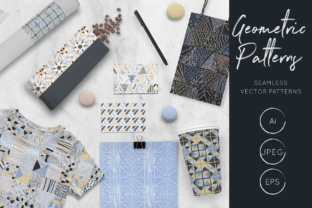
Geometric Patterns Flower Elements: Hand-Drawn Texture Meets Precision Design
Geometric Patterns Flower Elements is a curated digital collection that bridges organic imperfection and mathematical clarity. At its core, it offers five seamless, hand-inspired geometric patterns—each built from physical paper cut-outs rather than digital brushes or vector tools alone. This method introduces subtle irregularities: slight variations in line weight, soft edge breaks, and gentle asymmetry in floral motifs nested within grids, hexagons, triangles, and concentric shapes. Unlike many digitally generated geometric repeats—which often feel crisp, uniform, and predictable—these patterns retain the warmth of tactile making. That distinction matters most when texture, authenticity, and visual tactility are part of your design intention.
How It Differs From Standard Geometric Pattern Libraries
Most geometric pattern sets rely on algorithmic tiling or parametric generation. They’re efficient, scalable, and consistent—but can lack nuance at close inspection. Geometric Patterns Flower Elements deliberately avoids that uniformity. The paper-cut technique mimics the slight fraying, overlapping layers, and minor registration shifts you’d see in real-world collage or screen-printed textiles. When printed at 300dpi on wrapping paper or fabric, those micro-textural cues become perceptible: a faint shadow under a petal shape, a barely-there gap between two intersecting lines, or an uneven stroke where a paper edge was lifted mid-cut. These aren’t flaws—they’re intentional signatures of process.
This approach also affects flexibility. Because the base files are delivered as vector (AI) formats—not just raster JPEGs or PNGs—you retain full control over scale and colour without quality loss. Yet unlike purely digital vectors, these aren’t built from perfect circles or mathematically exact polygons. Their anchor points reflect manual placement, so resizing preserves character rather than amplifying sterility.
What’s Included—and Why Format Matters
The collection includes:
- 5 seamless AI vector files (CS3-compatible), each containing layered, editable colour groups—ideal for adjusting palettes or isolating floral elements;
- 5 high-resolution JPEGs (12×12 inches, 300dpi), ready for immediate print use on stationery or packaging;
- 15 transparent PNGs (300dpi), useful for digital scrapbooking, web overlays, or mockup integration;
- 10 standalone geometric flower elements (also 300dpi), designed to coordinate with the main patterns—think isolated blossoms, stylised stems, or abstract petal clusters you can reposition freely;
- All files are delivered at print-ready resolution, with no downsampling or compression compromises.
That combination—vector scalability plus high-fidelity raster assets—means you’re not forced to choose between adaptability and fidelity. Many designers working across both digital and physical outputs find themselves juggling multiple file types anyway; here, they’re provided together, intentionally aligned.
Practical Use Cases: Where These Patterns Shine
Geometric Patterns Flower Elements excels in contexts where craft sensibility meets functional repetition. Consider:
- Small-batch product design: A ceramicist printing custom gift wrap for holiday mugs might layer a gold foil overlay onto one of the vector patterns—then export a clean, sharp repeat for silkscreening. The hand-drawn origin ensures the final print feels artisan-made, not stock.
- Digital scrapbooking: The included PNGs work seamlessly in apps like Canva or Affinity Designer. Because each floral motif is isolated and transparent, users can build layered compositions without clipping masks or manual erasing.
- Apparel and textile prototyping: Fashion students or indie makers testing fabric prints benefit from the 12×12 inch JPEGs—they tile predictably in textile software (like Spoonflower’s preview tool) while retaining enough textural variation to avoid “digital flatness” on woven cotton or linen.
- Branded stationery: A boutique wedding planner might recolour the vector files to match a couple’s palette, then apply watercolour textures in Photoshop before exporting letterpress-ready PDFs. The underlying geometry keeps alignment tight; the hand-drawn edges keep it personal.
Tradeoffs and Realistic Limitations
No resource fits every need—and understanding where Geometric Patterns Flower Elements sits on the spectrum helps avoid mismatched expectations.
File size is large by design. With all assets saved at true 300dpi and vector layers preserved, downloads exceed typical pattern packs. That’s necessary for print integrity but may slow cloud syncing or require local storage management—especially if you’re working on older hardware or limited bandwidth.
It prioritises cohesion over variety. There are five core patterns—not fifty. Each is carefully balanced to share a common aesthetic language: shared line weights, compatible scale relationships, and recurring floral motifs. That makes mixing them intuitive, but it’s not a “grab-bag” library. If you need dozens of unrelated themes (e.g., Moroccan, Art Deco, Scandinavian folk), this isn’t the starting point.
Editing requires basic vector literacy. While the AI files are CS3-compatible (a widely supported version), modifying layers, adjusting blends, or applying gradients assumes familiarity with Illustrator’s interface. Beginners may find more value in the ready-to-use JPEGs and PNGs first, then gradually explore vector edits as confidence grows.
When to Choose This—And When to Look Elsewhere
Geometric Patterns Flower Elements is well-suited if you:
- Regularly produce physical goods (wrapping paper, fabric, stickers, phone cases) and value print-ready fidelity;
- Prefer patterns with quiet personality—neither overly rigid nor chaotically freeform;
- Work across both digital and print environments and need assets that translate cleanly between them;
- Want to add subtle luxury touches (gold foil, watercolour washes) without losing structural clarity;
- Appreciate knowing how something was made—the paper-cut origin informs how the pattern behaves visually and functionally.
It may be less ideal if you:
- Need ultra-minimalist, ultra-precise geometry (e.g., for architectural renderings or technical diagrams);
- Require hundreds of variations or rapid-fire experimentation with colour palettes alone;
- Are building UI interfaces or web backgrounds where small-file-size SVGs or CSS-generated patterns would be more efficient;
- Prefer fully automated tiling tools or generative design plugins that adjust repeats on-the-fly based on canvas size.
Final Considerations for Informed Selection
Evaluating pattern resources isn’t just about aesthetics—it’s about workflow fit, output requirements, and long-term reuse potential. Geometric Patterns Flower Elements stands out not because it offers the most options, but because its constraints are intentional: the paper-cut method defines its character, the vector+raster bundle supports dual-use needs, and the floral-geometric fusion creates a distinctive middle ground between botanical softness and structural rhythm.
If you’ve tested other pattern sets and found them either too mechanical or too loose, this collection offers a calibrated alternative—one grounded in physical process but engineered for digital flexibility. It doesn’t replace broader libraries, but it does fill a specific niche: where craft ethos meets repeatable precision.
Before downloading, consider opening one of the sample JPEGs at 100% zoom. Look for the places where lines taper, where a petal overlaps a triangle just slightly off-centre, where the white space between shapes feels earned—not calculated. That’s the signature. And for many designers, that subtle difference is exactly what makes a pattern feel like it belongs—not just in a project, but in a voice.