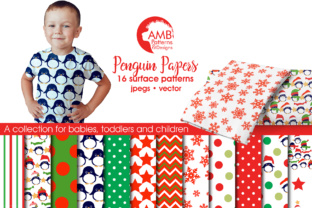
Penguin Papers: A Collection of Adorable Christmas-Themed Digital Papers
Penguin Papers refers to a curated set of digital design assets—specifically, 16 original 12×12 inch JPEG files featuring baby penguins dressed in festive Christmas attire. Released under the identifier AMB-1129, these papers are intended for creative use across print and digital projects. Each file is delivered at 300 dpi resolution, ensuring clarity for physical printing, and features hand-crafted clipart and patterns developed in-house.
Who Might Consider Penguin Papers?
This collection appeals primarily to crafters, small-business owners, educators, and hobbyists who regularly produce printed or digital materials. Common use cases include designing holiday invitations, scrapbooking layouts, gift tags, product packaging labels, greeting cards, and classroom decorations. Because the designs center on baby penguins in seasonal outfits—think tiny scarves, candy cane stripes, and miniature Santa hats—the collection suits lighthearted, family-friendly, or whimsical themes rather than formal or minimalist aesthetics.
Key Benefits to Evaluate
Consistent quality and usability: All 16 papers are uniform in size (12×12 inches) and resolution (300 dpi), simplifying integration into standard design workflows—especially for users working with scrapbooking software, Canva, Adobe Photoshop, or Illustrator. The JPEG format ensures broad compatibility without requiring specialized editing tools.
Original artwork: Unlike generic stock pattern libraries, Penguin Papers emphasizes custom clipart. This reduces the risk of visual overlap with other commercially available resources, supporting distinct brand or personal expression in finished pieces.
Thematic cohesion: With a unified subject (baby penguins) and seasonal motif (Christmas), the set offers immediate visual harmony. Users building multi-element projects—such as a full invitation suite with matching tags and envelopes—can maintain stylistic continuity without sourcing or editing disparate assets.
Tradeoffs and Practical Considerations
Limited theme scope: The Christmas focus means these papers are most relevant during the November–January window. While some elements (e.g., red-and-green color schemes or snowflakes) may extend to broader winter projects, they lack versatility for year-round or non-holiday applications.
No layered or editable source files: The collection includes JPEGs only—no PNGs with transparency, PSD layers, or vector formats (e.g., SVG or AI). That limits options for detailed customization, such as recoloring individual elements or isolating penguins from backgrounds. Users needing flexibility beyond cropping or resizing will need to rely on external editing tools or consider alternative asset types.
Fixed scale and composition: Because each paper is a full 12×12 inch background, adapting them for smaller formats—like business cards (3.5×2 inches) or sticker sheets—may require careful cropping to preserve key design elements. Repeating patterns aren’t included; each file is a unique, non-tiled layout.
When Penguin Papers Is a Strong Fit
This collection works well for users whose goals align with its specific strengths. For example:
- A small stationery shop owner creating a limited-run line of Christmas party invitations and coordinating thank-you cards.
- A parent organizing a children’s holiday craft event and needing printable activity pages, badges, and decorative borders.
- A scrapbooker documenting family traditions and seeking cohesive, cheerful backdrops for photo mats and journaling spots.
- A teacher preparing classroom materials—such as reward certificates or holiday-themed worksheets—with age-appropriate, engaging visuals.
In each case, the priority is visual appeal, thematic relevance, and ease of implementation—not deep customization or long-term reuse across multiple seasons.
When Alternatives May Be Worth Exploring
Consider other options if your needs differ significantly. For instance:
- You need editable components: Look for digital paper bundles that include PNGs or layered PSDs, especially if you plan to modify colors, remove backgrounds, or rearrange elements.
- Your project spans multiple holidays or seasons: A broader bundle—such as one covering winter, Christmas, New Year, and Valentine’s Day—may offer better long-term value than a single-theme set.
- You’re designing for commercial resale with strict licensing terms: Review the usage license carefully. Some digital paper licenses restrict use in items sold on platforms like Etsy unless an extended commercial license is purchased separately.
- You prefer scalable vector graphics: Vector-based penguin motifs (e.g., SVG cut files for Cricut or Silhouette machines) provide precision for cutting and resizing without quality loss—useful for physical crafting beyond flat printing.
Making a Practical Decision
Before acquiring Penguin Papers, clarify your intended output and constraints. Ask yourself:
- Is my project time-bound to the Christmas season—or does it benefit from lasting visual relevance?
- Do I need to alter individual design elements, or is using the papers as-is sufficient?
- What file formats do my tools support most efficiently? Will JPEGs integrate smoothly into my current workflow?
- How many distinct patterns do I realistically need? While 16 papers offer variety, many users find 6–8 cohesive designs adequate for a single project.
Also verify technical details: confirm that your printer or print-on-demand service accepts 12×12 inch JPEGs at 300 dpi, and test a sample file for color accuracy and sharpness before committing to large-scale production.
Final Thoughts
Penguin Papers AMB-1129 delivers a focused, high-quality solution for creators seeking cheerful, Christmas-themed digital papers with consistent formatting and original artwork. Its value lies in thematic unity and out-of-the-box usability—not adaptability or breadth. It serves best when matched to short-term, visually driven projects where charm and seasonal resonance matter more than structural flexibility. As with any digital asset, alignment with your specific goals, tools, and timeline determines whether it supports your work effectively—or whether another resource better fits your practical requirements.