7 Flowers and Floral Patterns
7 Flowers and Floral Patterns is a curated collection of seven distinct floral vector designs, delivered in industry-standard formats: Adobe Illustrator (Ai), Encapsulated PostScript (Eps), and Scalable Vector Graphics (Svg). Each design is built as a clean, editable vector—meaning it retains sharpness at any scale and supports full customization of strokes, fills, and individual elements. The set emphasizes versatility over stylistic uniformity: motifs range from delicate botanical silhouettes to structured, repeat-ready arrangements, all designed to function across physical and digital applications.
People exploring this collection typically fall into one of several overlapping groups: graphic designers sourcing assets for client work, crafters developing embroidery or print-on-demand products, small business owners creating branded stationery or packaging, and educators or hobbyists building teaching materials or personal projects. Their shared need is not novelty alone—but reliable, production-ready floral graphics that integrate smoothly into existing workflows without requiring advanced vector editing skills.
A primary benefit lies in format flexibility. Ai and Eps files support deep layering and path manipulation in professional design software, while Svg ensures compatibility with web-based tools, cutting machines (like Cricut or Silhouette), and many embroidery digitizing platforms. Because each floral pattern is vector-based—not raster—the user can resize it for a business card logo or a wall mural without quality loss. Color adjustment is straightforward: users can replace default palettes with brand-aligned hues or seasonal tones using standard fill tools, making the set adaptable to diverse aesthetic requirements.
The inclusion of seven distinct patterns also supports compositional variety. Rather than relying on a single motif repeated across multiple contexts, users can mix and match—for example, pairing a bold, symmetrical bloom as a central logo element with a subtler vine pattern as a border for greeting cards. This modularity reduces visual fatigue in long-running projects like product lines or social media branding. Additionally, the absence of embedded textures or effects means the vectors serve equally well for screen display, fabric printing, foil stamping, or laser engraving—provided output resolution and color mode (CMYK vs. RGB) are verified per use case.
However, certain tradeoffs accompany this flexibility. These are not hand-drawn illustrations with organic imperfections; they are precise, scalable vectors optimized for consistency—not expressive texture. Users seeking watercolor washes, pencil sketch lines, or painterly brushwork will need to augment the files with additional layers or external assets. Likewise, while colors are fully editable, the base files do not include pre-built multi-color variants or gradient swatches—customization requires manual input. This is intentional: it preserves file lightness and avoids assumptions about end-use color systems.
Another consideration is licensing scope. The description notes suitability for products, embroidery, greeting cards, logos, and wallpapers—but does not specify commercial redistribution rights (e.g., selling the unaltered vector as a standalone digital product). Users intending resale must verify license terms separately, as usage rights vary by vendor and may restrict derivative asset stores or template marketplaces. For internal or client-facing deliverables—such as a boutique’s holiday packaging or a wedding planner’s invitation suite—the set functions without complication.
This collection is a strong fit when the priority is efficiency in execution across multiple output types. A textile designer prototyping scarf prints benefits from the ability to test layout variations at actual fabric scale. A stationery maker preparing a set of thank-you cards can isolate petal shapes to create custom corner flourishes. A branding consultant developing a wellness studio’s identity can extract stem elements to build a monogram or icon system. In each case, the value stems from interoperability—not just between software, but between disciplines.
Conversely, alternatives may be preferable in specific scenarios. If a project demands photorealistic floral photography or AI-generated botanical imagery for mood boards or presentations, vector patterns won’t fulfill that role. Similarly, users needing tightly integrated, grid-based seamless repeats for wallpaper or fabric may find the individual patterns require additional tiling setup—though the vector nature makes that setup feasible, it isn’t automated. For those prioritizing speed over control, pre-made PNG overlays with drop shadows or textures might reduce initial setup time, albeit at the cost of scalability and editability.
Decision-making hinges on two practical questions: First, what is the intended output medium? If final delivery includes large-format printing, embroidery, or vector-dependent manufacturing (e.g., vinyl cutting), then 7 Flowers and Floral Patterns aligns well. Second, what level of design control is needed? If adjustments beyond color swaps—such as reshaping petals, adjusting stroke weights, or combining elements into new compositions—are expected, the editable vector structure supports that. But if the goal is “plug-and-play” decoration with minimal intervention, simpler raster bundles or font-based floral dingbats may involve less learning curve.
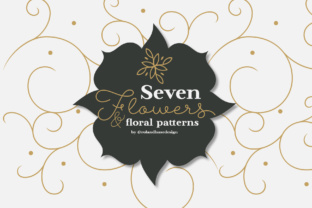
It’s also worth noting the typography referenced for the cover image—Abigail Script and Beaumaris—suggests an aesthetic leaning toward elegant, humanist forms. While not part of the floral files themselves, this pairing signals compatibility with serif and script type treatments common in artisanal branding, luxury goods, or wedding-related design. Users working in adjacent visual territories can treat the fonts and floral motifs as complementary components rather than isolated assets.
In summary, 7 Flowers and Floral Patterns serves as a functional foundation—not a finished solution. Its strength resides in adaptability across scale, medium, and color context, grounded in open, editable formats. It does not replace conceptual development or stylistic refinement, but it removes technical barriers to executing floral-themed work consistently. For practitioners who value precision, reusability, and cross-platform compatibility—and who understand that customization is part of the process—this collection offers tangible utility. For those whose needs center on rapid deployment without editing, or on expressive, non-vector aesthetics, evaluating supplementary or alternative resources remains advisable.