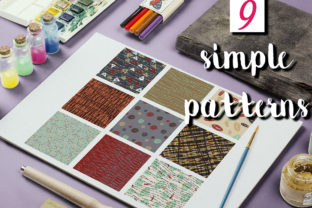
9 Simple Patterns: Your Go-To Resource for Clean, Scalable Design Foundations
If you've ever spent 45 minutes tweaking a background texture only to realize it won’t scale for print—or worse, pixelates on a client’s large-format banner—then 9 Simple Patterns is the quiet solution you’ve been overlooking. It’s not flashy software or a subscription service. It’s a tightly curated, thoughtfully built collection of nine minimalist, repeatable motifs—delivered in formats that actually work across real-world creative workflows.
What You’re Actually Getting (and Why Format Variety Matters)
This isn’t just “nine patterns in a ZIP file.” It’s nine intentional, balanced designs—think subtle grids, soft organic lines, refined geometric repeats, and understated tonal shifts—each engineered for flexibility. And because how you use them depends entirely on your project, the archive gives you options that respect your process:
- Vector EPS files — Ideal for logo integration, packaging mockups, or any situation where you need crisp, resolution-independent scaling (e.g., engraving on metal signage or embroidering onto fabric swatches).
- Vector AI files — Perfect if you're deep in Adobe Illustrator and want to tweak colors, adjust spacing, or isolate elements without losing vector integrity—say, adapting a pattern to match a brand’s exact Pantone palette.
- JPEGs (4000 × 4000 px) — High-res, ready-to-drop assets for web banners, social media templates, or digital presentations where vector isn’t supported (like certain CMS editors or email builders).
- PSD files (300 dpi, RGB, layered) — Each pattern element lives on its own layer. That means you can mute, recolor, or reposition individual components non-destructively—useful when designing stationery suites, UI overlays, or mood board visuals.
No guesswork. No format conversion headaches. Just what you need, when you need it.
Where These Patterns Show Up in Real Life (Beyond “Just Backgrounds”)
Designers often reach for patterns when they need visual rhythm—not decoration. Here’s where 9 Simple Patterns quietly earns its place in daily work:
Small Business Branding That Feels Intentional
A local ceramics studio doesn’t need a loud logo—it needs cohesion. One of these patterns, softened and tinted to match their glaze palette, becomes the subtle texture behind business cards, wraps around product tags, and fills the negative space in Instagram story highlights. Because each pattern is simple and low-contrast, it supports the product—not competes with it.
Architectural & Interior Visualizations
When rendering a residential interior, surface texture sells realism. A soft linear pattern at 15% opacity on a wall panel in your SketchUp or Revit render adds tactile depth—without looking “designed.” The EPS and PSD versions let you map it cleanly to curved surfaces or adjust scale to match real-world tile or wood grain proportions.
Educational & Nonprofit Materials
Infographics, annual reports, and donor decks benefit from structure—not clutter. A light grid-based pattern as a page background (using the JPEG or PSD) creates gentle visual hierarchy, guiding the eye without demanding attention. Teachers and NGO staff appreciate that it prints cleanly at 300 dpi and stays legible even when photocopied or projected.
Web & UI Design (Yes, Really)
While CSS can generate basic patterns, complex responsive behavior—like seamless tiling across variable screen widths or consistent appearance on high-DPI displays—isn’t trivial. Dropping in one of the high-res JPEGs as a background image (with background-size: 200px;) delivers predictability. Or, use the AI file to export SVG tiles for true scalability in modern front-end builds.
Who Benefits—and How Their Needs Differ
A freelance graphic designer might open the AI files first—tweaking stroke weight and hue to align with a client’s new brand guide. A textile artist may import the EPS into a weaving software, using the clean vector paths as direct loom instructions. A marketing manager building a Canva template? They’ll likely grab the JPEGs—drag, drop, done—no design app required.
Even educators find value: one art teacher uses the layered PSDs to demonstrate “design thinking in layers”—showing students how adjusting opacity, blending modes, or color balance transforms intent. The simplicity of 9 Simple Patterns makes it accessible, but the precision of the files keeps it professional.
Things to Keep in Mind Before You Use Them
These patterns are intentionally restrained—so they won’t “pop” like bold illustrations or photo textures. That’s by design. If your goal is visual dominance, this isn’t the tool. But if your aim is harmony, consistency, or quiet sophistication, it fits seamlessly.
Also worth noting: while all files are RGB (ideal for screen and standard print), they’re not pre-separated for CMYK offset printing. If you’re producing large runs on uncoated stock, a quick test print is wise—especially with the softer tonal patterns, which can shift subtly depending on paper absorbency.
And although the patterns are royalty-free for personal and commercial use, always double-check your specific license terms—particularly if embedding into SaaS platforms or white-labeled products where redistribution rules may apply.
Why Simplicity Isn’t a Limitation—It’s Leverage
In a world of overwhelming design choices, 9 Simple Patterns works because it removes decision fatigue without sacrificing quality. You’re not choosing *from* hundreds—you’re choosing *the right one* for the job at hand. That grid pattern? It anchors data tables. That wavy line motif? It softens a tech startup’s otherwise rigid interface. That dot field? It adds breathing room to minimalist packaging.
There’s no learning curve. No plugin to install. No account to create. Just clean, versatile, production-ready assets—organized so you spend less time prepping and more time solving.
Whether you’re refining a pitch deck at midnight, prepping files for a print shop at noon, or iterating on a client’s brand system over coffee—these nine patterns hold space for your ideas, not distract from them.