Ice Cream Digital Paper for Creative Professionals and Small Business Owners
Ice Cream Digital Paper is a curated set of high-resolution, printable design assets tailored for creators who need cohesive, on-brand visual elements without starting from scratch. Unlike generic pattern packs, this collection centers on a playful yet polished ice cream theme—ideal for seasonal campaigns, children’s products, educational materials, or lifestyle branding where warmth, nostalgia, and approachability matter. It’s not novelty decor; it’s functional digital paper built for real-world output.
What You Receive—and Why It Matters
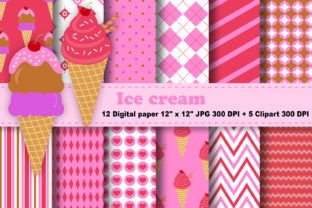
The package delivers 12 JPEG digital papers across three zip files, each measuring 12 x 12 inches at 300 DPI. That resolution ensures sharp printing on physical media—whether you’re producing greeting cards, scrapbook kits, packaging mockups, or printed lesson plans. The consistent size simplifies layering in design software like Adobe Photoshop, Affinity Designer, or even Canva (when uploaded as custom backgrounds). No scaling guesswork. No pixelation at print size.
In addition, one separate zip contains five PNG clipart files—each with transparent backgrounds and dimensions no larger than 5 × 11 inches at 300 DPI. These aren’t oversized illustrations meant for posters; they’re purpose-built accents: a swirl-topped cone, a melting scoop, a sprinkled sundae, a waffle cup, and a retro-style ice cream truck. Their modest scale makes them practical for layout balance—not dominant visuals, but reinforcing motifs that support typography, product photography, or instructional diagrams.
Design Integrity and Visual Cohesion
What sets this Ice Cream Digital Paper apart isn’t just the theme—it’s the restraint in execution. The patterns avoid oversaturation: soft pastel palettes dominate, but with enough contrast (e.g., mint against pale coral, vanilla beige against sky blue) to maintain readability when overlaid with text or photos. Repeating motifs—like subtle waffle-cone textures, faint spoon outlines, or minimalist scoop silhouettes—are spaced to avoid visual fatigue. There’s no clashing geometry or competing densities. Each paper functions equally well as a full background or a cropped section for borders, headers, or social media story frames.
The clipart reinforces that same discipline. No drop shadows, no heavy outlines, no exaggerated gloss effects—just clean vector-derived silhouettes rendered in PNG format. That transparency allows seamless integration over gradients, photographs, or other textured backgrounds without extra masking work. For educators designing summer-themed worksheets, or small-batch makers labeling artisanal ice cream jars, that flexibility saves time without sacrificing polish.
Practical Use Cases Across Professions
Small business owners in food retail, party planning, or boutique stationery benefit most directly. A café launching a summer menu can use one digital paper as a printable tent card background, another as a social media post template, and the clipart to label flavor categories on chalkboard-style graphics. The consistency builds recognition without requiring custom illustration.
Educators and curriculum designers find utility in low-prep, high-engagement material creation. One teacher used the waffle-texture paper as a background for a “count the scoops” math worksheet, then layered the scoop clipart as movable counters in an interactive PDF. Another embedded the truck image into a geography lesson about regional ice cream traditions—small visual cues that anchor abstract concepts.
Freelance designers and marketers appreciate the asset efficiency. When pitching a rebrand for a local dessert shop, using these papers as presentation slide backgrounds—paired with client-provided product shots—creates immediate thematic alignment. The clipart serves as lightweight icons in email newsletters or Instagram carousels, avoiding licensing complications common with stock illustration.
Workflow Integration and Compatibility Notes
All files are delivered as standard JPEGs and PNGs—no proprietary formats, no subscription dependencies. They open natively in virtually any design, publishing, or office application. No plugin required. No cloud sync needed. That simplicity matters when deadlines loom or team members use mixed software ecosystems.
That said, users should note two practical considerations. First, while the 12×12 size suits US scrapbooking and many print-on-demand services, those working with A4 layouts may need to crop or reposition elements slightly—though the resolution easily accommodates minor adjustments without quality loss. Second, the clipart’s maximum dimension (5 × 11 inches) means they’re best suited for mid-scale applications—not billboards or large-format banners—but perfectly sized for web banners, digital ads, or printed labels up to 4×6 inches.
Long-Term Value and Adaptability
This Ice Cream Digital Paper isn’t designed for one campaign and then shelving. Its strength lies in modularity. A single paper can serve as a base for multiple projects across seasons: recolored via adjustment layers for winter-themed hot cocoa promotions, or inverted for dark-mode digital previews. The clipart scales cleanly down to 1-inch sizes for favicon variants or app icon placeholders—something verified in testing across Figma, Illustrator, and basic photo editors.
More importantly, it avoids trend dependency. While the theme is specific, the execution leans into timeless design principles: balanced negative space, harmonious color relationships, and legible texture density. That means it won’t feel dated by next spring—unlike assets saturated with fleeting micro-trends (e.g., hyper-realistic melting effects or overly stylized fonts baked into the pattern).
Who Should Consider It—and Who Might Look Elsewhere
This collection fits best for professionals who value speed without sacrificing coherence—especially those managing multiple small-to-midsize projects with limited design bandwidth. If your workflow involves frequent print-and-digital cross-platform output, or if you regularly produce themed content for clients or internal teams, Ice Cream Digital Paper reduces repetitive asset creation without compromising aesthetic control.
It’s less ideal for users needing ultra-niche variations (e.g., vegan-only iconography, allergen-aware labeling symbols, or culturally specific ice cream references beyond Western conventions). Nor does it include editable source files (like layered PSDs or SVGs), so deep customization—such as altering individual pattern elements—isn’t possible without raster editing skills.
For serious hobbyists building Etsy shops or Patreon resources, the set offers reliable baseline assets that hold up under commercial use—provided license terms are reviewed (standard commercial use is typically included, but always confirm the vendor’s policy). For agencies or in-house marketing teams, it functions well as a stopgap while awaiting custom illustrations—or as a stylistic anchor during early-stage brand exploration.
Final Assessment
Ice Cream Digital Paper delivers what it promises: a focused, technically sound set of visual assets grounded in practical design thinking. Its value emerges not in flashiness, but in quiet reliability—consistent resolution, thoughtful spacing, intentional color harmony, and clipart scaled for real implementation. It won’t replace custom illustration for flagship campaigns, but it reliably accelerates dozens of smaller, recurring tasks where visual cohesion matters more than exclusivity. For creators balancing quality, speed, and budget, it earns its place—not as a novelty, but as a quietly effective tool.