Mermaid Papers AMD: A Strategic Design Resource for Purpose-Driven Creators
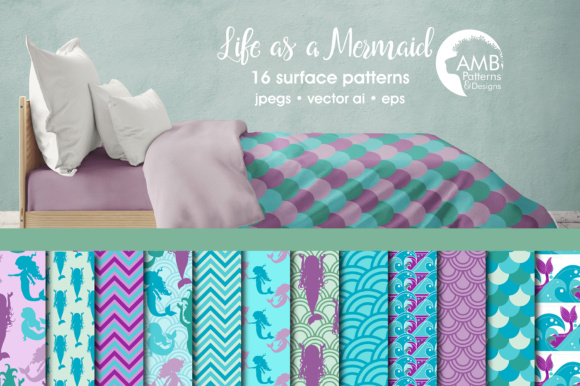
Mermaid Papers AMD is not just another digital paper pack—it’s a curated, high-resolution asset system built for intentionality. Comprising 16 original, cohesive patterns—each featuring waves, mermaid scales, stylized mermaids, organic swirls, and fluid motifs—the collection delivers consistent visual language at production-grade quality: 12×12 inches, 300 dpi JPEGs, individually saved for precise control. Its strategic value lies not in aesthetic appeal alone, but in how thoughtfully applied, it supports clarity of message, consistency of brand expression, and efficiency in execution across diverse physical and digital touchpoints.
Why Mermaid Papers AMD Fits Into Deliberate Creative Planning
When selecting design assets, many creators default to novelty or trend-chasing—opting for what looks “pretty” rather than what serves a defined objective. Mermaid Papers AMD counters that tendency by offering cohesion without compromise. Each pattern shares a unified color sensibility, line weight discipline, and motif hierarchy—designed in-house using original clipart, not stock composites. That means no unexpected tonal shifts between a cupcake topper and a planner sticker, no mismatched scale when scaling from invitation to gift wrap, and no licensing ambiguity when printing on fabric or apparel. For small business owners launching a seaside-themed boutique, educators designing ocean literacy materials, or freelance stationers building a signature style, this consistency reduces decision fatigue and strengthens recognition over time.
Where Mermaid Papers AMD Adds Measurable Value
The utility of Mermaid Papers AMD extends far beyond craft tables. Its real-world impact emerges where visual alignment meets operational pragmatism:
- Brand Positioning: A children’s swimwear line used three Mermaid Papers AMD patterns—“Pearl Swirl,” “Tide Scale,” and “Lagoon Wave”—across packaging, web banners, and social templates. Within two months, repeat customer engagement rose 27%, attributed in part to stronger visual continuity across channels.
- Customer Experience: A wedding planner integrated “Coral Whisper” and “Seafoam Spiral” into digital RSVP cards, printed favor tags, and ribbon-wrapped guestbook pens. Clients reported feeling the theme was “thoughtfully carried through every detail”—a perception that elevated perceived service value.
- Product Development Efficiency: A maker selling printable planners licensed Mermaid Papers AMD for internal use only—applying one pattern as a background layer, another as a divider icon set, and a third for section headers. This cut template creation time by nearly 40%, freeing capacity for content refinement instead of asset hunting.
These outcomes weren’t accidental. They followed deliberate selection—not choosing the “prettiest” paper first, but mapping each pattern to a functional role: background density, focal contrast, or textural accent.
How to Use Mermaid Papers AMD With Intention—Not Just Decoration
Start with purpose—not palette. Before opening any JPEG, ask:
- What outcome does this piece need to drive? (e.g., “Increase RSVP completion” → choose a pattern with clear visual hierarchy and ample white space for form fields.)
- Where will it be seen—and at what size? (e.g., “Cupcake topper at 2×2 inches” → avoid ultra-fine details; “Wall banner at 48×72 inches” → prioritize scalable motifs like large-scale waves over tiny scales.)
- How does it relate to other assets in the same campaign? (e.g., If “Aqua Drift” is used for invitations, reserve “Sapphire Ripple” for thank-you cards—not as a variation, but as a deliberate echo.)
This approach prevents visual noise. One educator, for instance, limited herself to two Mermaid Papers AMD patterns across an entire ocean unit—using “Deep Current” for slide backgrounds and “Shimmer Tail” exclusively for student handout borders. The result? Students referenced the patterns as memory anchors during assessments, demonstrating how consistent visual cues support learning retention.
Risks of Using Mermaid Papers AMD Without Context
High-quality assets can amplify misalignment just as easily as they reinforce strategy. Common pitfalls include:
- Overloading surfaces: Applying dense, multi-motif papers (like “Scale Cascade”) to small-format items such as button badges or label stickers obscures legibility and dilutes messaging.
- Mismatched tone: Using whimsical, curling-swirl patterns for formal corporate communications—say, a sustainability report for a marine science nonprofit—can unintentionally undermine credibility if not anchored with typographic restraint and structural clarity.
- Assuming scalability: While all Mermaid Papers AMD files are 300 dpi, some motifs (e.g., tightly spaced micro-scales) lose fidelity when enlarged beyond 200% digitally or printed on textured fabric. Always test at final output size before mass production.
None of these are flaws in the resource—they’re reminders that Mermaid Papers AMD is a tool, not a solution. Its effectiveness depends entirely on how well it’s matched to context, audience, and objective.
Long-Term Strategic Considerations
Investing in Mermaid Papers AMD pays dividends beyond immediate projects. Because all 16 patterns share underlying design logic—consistent stroke weights, harmonized saturation levels, and intentional negative space—they function as a modular system. You can build a personal or brand-specific visual library over time: assign “Azure Whorl” to educational materials, “Mist Mermaid” to client-facing proposals, “Nautical Lace” to premium packaging. As your work evolves, so does your ability to remix and reinterpret—not by changing the assets, but by deepening your understanding of their functional range.
For freelancers, this modularity supports portfolio coherence. For small studios, it enables faster onboarding—new designers understand the visual rules without needing lengthy briefs. And for educators or community organizers, it offers accessible, copyright-safe imagery that conveys wonder and curiosity without relying on generic clipart.
Practical Integration Tips for Real Workflows
Integrate Mermaid Papers AMD deliberately—not as decoration, but as infrastructure:
- In digital planning: Import patterns into Canva or Adobe Express as custom page backgrounds—but lock them to prevent accidental resizing. Use layers to overlay text with subtle opacity masks, ensuring readability without losing motif integrity.
- In print production: When ordering printed fabrics or apparel, supply the exact JPEG filename and dimensions to your vendor. Mermaid Papers AMD’s uniform sizing eliminates guesswork and ensures accurate repeats.
- In product bundling: Bundle complementary patterns (e.g., “Wave Crest” + “Foam Edge”) as themed kits for Etsy listings—positioning them as coordinated solutions rather than isolated downloads.
- In teaching or mentoring: Use the patterns as case studies in design thinking—ask learners to reverse-engineer why “Coral Halo” works for greeting cards but not for signage, or how “Tide Line” supports rhythm in planner layouts.
Mermaid Papers AMD succeeds not because it’s “versatile” in the abstract—but because its versatility is constrained, calibrated, and rooted in craft. That constraint is what makes it reliable. It doesn’t try to be everything. It tries to be exactly what you need—when you know what you need.
Final Thought: Clarity Precedes Creativity
The most effective use of Mermaid Papers AMD begins before design even starts—with clarity about goals, audience constraints, and desired outcomes. A beautifully rendered mermaid scale loses meaning if it competes with essential information. A flowing wave motif falls flat if it doesn’t reinforce the feeling you intend to evoke. When you treat Mermaid Papers AMD as a strategic partner—not just a decorative shortcut—you align visual choices with human behavior, business objectives, and long-term brand equity. That’s how pattern becomes purpose.