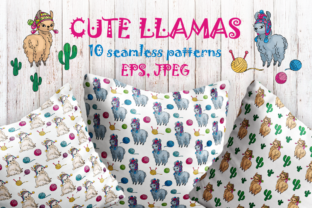
Cute Llamas Doodles Seamless Patterns: A Practical Guide for Designers and Crafters
Seamless patterns offer a reliable foundation for textile design, stationery, web backgrounds, packaging, and digital illustration—but not all pattern sets deliver equal flexibility or creative control. Cute Llamas Doodles Seamless Patterns is a curated collection built around playful, hand-drawn llama motifs rendered in a light, approachable doodle style. Unlike photorealistic animal graphics or rigid geometric repeats, this package emphasizes charm, rhythm, and scalability without visual fatigue. Its defining trait isn’t novelty alone—it’s the balance between expressive illustration and functional seamlessness.
What Makes This Pattern Set Distinct?
The core offering includes 10 unique seamless patterns, each designed with consistent line weight, spacing, and negative space to support readability at small scales (like fabric swatches or social media avatars) and impact at large formats (such as wall murals or apparel prints). Each pattern is delivered in two essential formats: EPS vector files and high-resolution JPEGs (5000 × 5000 pixels, 300 DPI). That dual-format delivery matters—EPS files retain infinite scalability and allow full editing of individual elements (e.g., recoloring llamas, adjusting stroke thickness, or rearranging clusters), while the JPEGs provide immediate use in raster-based workflows like Canva, Photoshop, or Procreate without requiring vector expertise.
Unlike generative AI pattern tools that produce unpredictable repeats or stock sites where licensing terms vary widely, Cute Llamas Doodles Seamless Patterns offers clear ownership: once downloaded, the files are yours to modify, combine, or commercialize per standard extended license terms (always verify the specific license included with purchase). There’s no subscription, no usage cap, and no attribution requirement—just direct access to editable assets.
How It Compares Across Common Pattern Use Cases
Designers evaluating pattern resources often weigh tradeoffs across three axes: editability, visual cohesion, and technical reliability. Here’s how Cute Llamas Doodles Seamless Patterns fits into real-world decision contexts:
- For print-on-demand creators: The 300 DPI JPEGs meet platform requirements for Spoonflower, Redbubble, and Printful without upscaling artifacts. Vector EPS files let you isolate single llamas to create coordinating icons or monograms—something flat PNG bundles can’t support without pixelation.
- For educators or crafters: The doodle aesthetic reads clearly when printed on vinyl stickers, scrapbook paper, or classroom posters. Compared to highly detailed watercolor animal patterns, these retain legibility even after multiple photocopies or low-ink printing.
- For UI/UX designers: While not intended for interface elements like buttons or cards, the patterns work well as subtle animated backgrounds (via CSS or Lottie) or as texture overlays in Figma prototypes—especially where warmth and approachability matter more than strict minimalism.
Strengths and Practical Tradeoffs
The most consistent strength is stylistic consistency. All 10 patterns share the same linework language, scale relationship, and spacing logic—so mixing them within one project (e.g., a children’s book cover with border, background, and icon layer) feels intentional, not accidental. That cohesion reduces time spent harmonizing disparate assets.
A notable tradeoff is scope: this is a focused set, not an ecosystem. You won’t find matching color palettes, SVG icons, or font pairings bundled in. If your workflow depends on coordinated brand kits—or if you need variants like dark-mode versions or halftone overlays—you’ll need to build those extensions yourself or source them separately. Similarly, while the llamas are charming, they anchor the set firmly in lighthearted, friendly, or youthful contexts. They’re less suited for luxury branding, medical communications, or corporate reports where tonal neutrality or gravitas is required.
Another practical consideration: seamless doesn’t mean “invisible.” These patterns have clear rhythm and repetition. In large-scale applications (e.g., full-wall wallpaper), viewers may notice the repeat unit. That’s typical for any seamless pattern—but it’s worth testing at actual size before committing to production. Previewing one JPEG tile at 100% zoom in Photoshop or dragging it into a browser with background-repeat: repeat gives a realistic sense of flow.
When It Fits—and When It Doesn’t
Cute Llamas Doodles Seamless Patterns is especially appropriate when:
- You’re designing for audiences that respond well to whimsy—think baby shower invites, educational materials for early learners, boutique pet product labels, or indie stationery brands.
- Your project requires both vector precision (for logo integration or cut-file preparation) and high-res raster fallbacks (for social banners or email headers).
- You prefer working with hand-crafted illustration over algorithmically generated textures or overly stylized clipart.
- You value having full file control without navigating complex licensing tiers or monthly fees.
It’s less ideal when:
- Your timeline demands immediate plug-and-play assets with zero customization—e.g., uploading directly to a POD platform without checking tile alignment or color mode.
- You need photorealistic, anatomically accurate, or culturally specific animal representations—the doodle style prioritizes expressiveness over realism.
- Your project calls for strict adherence to WCAG contrast guidelines across all pattern variations. While the base files use high-contrast black-on-white or soft pastel fills, contrast ratios shift significantly when recolored; manual verification remains necessary.
- You require scalable pattern libraries with hundreds of motifs—for broad variety, modular systems, or multi-category projects (e.g., animals + food + nature), a larger or more segmented collection may better serve long-term needs.
Realistic Integration Examples
A small-batch candle maker used four patterns from Cute Llamas Doodles Seamless Patterns to differentiate their seasonal lines: one for spring (pastel llamas with floral accents), another for holiday (llamas wearing scarves, tiled subtly behind gift tags). They edited the EPS files in Illustrator to replace default colors with their brand palette, then exported new JPEGs optimized for Etsy thumbnails.
An elementary art teacher printed two patterns onto cardstock, cut them into puzzle pieces, and used them for a symmetry lesson—students identified repeat units, traced motifs, and created their own simplified versions. The consistent scale and clear outlines made the activity accessible across grade levels.
A freelance illustrator licensed the set for a client’s children’s app onboarding screens. Rather than using full repeats, they extracted single llama doodles from the EPS files, resized and layered them as interactive hotspots—leveraging the vector source for crisp rendering across device densities.
Making Your Decision
If you’re comparing pattern resources, consider what portion of your workflow hinges on flexibility versus speed. Cute Llamas Doodles Seamless Patterns leans toward the former: it rewards time invested in customization but delivers strong baseline quality out of the box. It avoids overpromising—there are no AI enhancements, no auto-resizing magic, no cloud sync. What you get is ten thoughtfully constructed, technically sound, and stylistically unified seamless patterns, ready to adapt to your process—not the other way around.
Before downloading, ask yourself: Do I need to change colors, resize elements, or extract parts? Will this support my output formats (print, web, embroidery, vinyl)? Does the tone align with my audience’s expectations—not just now, but six months from now? If the answer to most of those is yes, Cute Llamas Doodles Seamless Patterns is a grounded, reusable asset—not a trend-dependent shortcut.