Flamingo Digital Paper: A Practical Guide for Crafters and Designers
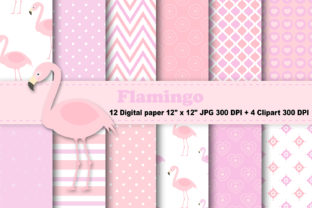
Flamingo Digital Paper refers to a curated collection of high-resolution, printable digital design assets—specifically 12 unique JPEG patterns delivered across three zip files, each sized at 12 x 12 inches and rendered at 300 DPI. Complementing these are four transparent-background PNG clipart files, also at 300 DPI, with maximum dimensions of 7 inches by 11 inches. Unlike generative or subscription-based tools, Flamingo Digital Paper is a fixed, downloadable asset pack—designed for immediate use in physical and digital projects where consistency, color harmony, and print-ready quality matter.
What Sets Flamingo Digital Paper Apart
Most digital paper collections prioritize either sheer volume or stylistic variety—but Flamingo Digital Paper balances both while emphasizing practical output. Its 12 patterns are not random repeats; they’re coordinated around a cohesive visual language—soft gradients, subtle texture overlays, and balanced contrast—that supports layering without visual competition. Because all files are JPEGs at full 12 x 12 sheet size and 300 DPI, users avoid the common pitfalls of scaling up low-res assets or stitching together tileable swatches. This makes Flamingo Digital Paper especially useful when preparing files for professional printing—such as scrapbook layouts, custom stationery, planner inserts, or small-batch product packaging.
The included clipart (four PNGs, transparent background, 300 DPI) extends that utility. Rather than generic icons, these are purpose-scaled elements—measuring up to 7" × 11"—so they hold clarity when placed on full-page layouts or resized down for labels and tags. Their transparency means they integrate cleanly over any of the 12 papers without clipping or color bleed, supporting mixed-media workflows without extra masking work.
How It Compares to Other Digital Paper Options
Digital paper comes in many forms: tileable seamless patterns (often sold in bundles of 50+), AI-generated one-offs, subscription libraries with rotating access, or hand-scanned vintage textures. Flamingo Digital Paper sits between the minimalist and the expansive—neither overwhelming nor under-resourced. Where tileable patterns require technical knowledge to repeat seamlessly in design software, Flamingo’s JPEGs are “print-and-go”: no tiling, no alignment adjustments, no transparency concerns. That simplicity saves time for users who value reliability over flexibility.
Compared to AI-generated digital papers, Flamingo offers predictability. AI outputs can vary widely in grain, contrast, and saturation—even within the same prompt—and rarely guarantee consistent DPI or usable white space. With Flamingo, what you see in the preview is what prints, pixel-for-pixel. That matters when building brand-aligned materials or maintaining continuity across multi-page documents.
Subscription-based libraries offer breadth but introduce dependency: access ends if the service changes pricing or shuts down. Flamingo Digital Paper is a one-time acquisition—no logins, no renewals, no usage limits. You download it, store it locally, and use it indefinitely—even offline. That permanence aligns well with users who manage long-term creative archives or collaborate across teams with varying software access.
Strengths and Real-World Fit
Flamingo Digital Paper excels in three overlapping scenarios:
- Print-first workflows: If your end goal is physical output—scrapbook pages, greeting cards, fabric transfer sheets, or die-cut labels—the 12 x 12 size and 300 DPI ensure sharp results on home printers or commercial presses. No interpolation, no guesswork.
- Cohesive branding within constraints: Small businesses designing limited-run product packaging or event kits benefit from having exactly 12 coordinated patterns—not 100 uncurated ones. It reduces decision fatigue while still offering enough variation for visual rhythm.
- Hybrid analog-digital creation: Journalers using digital planning apps (like GoodNotes or Notability) often import JPEGs as notebook backgrounds. Flamingo’s resolution and sizing match standard tablet canvases without distortion—especially helpful when zooming or annotating.
The clipart adds functional versatility. For example, a wedding planner might use one Flamingo pattern as a suite background, overlay a flamingo-shaped clipart as a motif, and place text directly over the transparent area—without needing to adjust blending modes or opacity. Similarly, an educator creating printable flashcards can drop the same clipart onto multiple pattern backgrounds to maintain visual interest while reinforcing theme consistency.
Tradeoffs and Limitations to Consider
No digital paper collection is universally ideal—and Flamingo Digital Paper reflects intentional tradeoffs. It does not include vector files (AI, EPS, SVG), so users requiring infinite scalability for large-format signage or embroidery digitizing will need supplemental assets. It also lacks editable layers (PSD, TIFF with layers), meaning color adjustments must be done non-destructively in compatible software—or accepted as-is.
Because the patterns are JPEGs—not seamless tiles—they aren’t suited for web backgrounds that require infinite horizontal/vertical repetition. Nor do they support dynamic color-swapping like CSS variables or SVG filters. If your workflow depends heavily on real-time recoloring or responsive layout behavior, Flamingo Digital Paper serves better as a finishing asset than a foundational one.
Also worth noting: the clipart set is intentionally modest—four pieces, not forty. That’s an advantage for focused projects but may feel limiting for users building extensive icon systems or needing seasonal variants (e.g., holiday-themed alternatives). In those cases, pairing Flamingo Digital Paper with a separate, specialized clipart library may be more efficient than seeking an all-in-one solution.
When to Choose Flamingo Digital Paper—and When to Look Elsewhere
Choose Flamingo Digital Paper if you value:
- Consistent, print-ready resolution without post-download editing;
- A manageable number of thoughtfully coordinated patterns;
- Transparent PNG clipart that scales cleanly alongside those patterns;
- Ownership and offline usability over cloud-dependent access.
It’s especially appropriate for intermediate crafters who’ve moved past free blog-downloads but aren’t yet managing enterprise-level asset libraries—and for professionals who need reliable, licensable materials for client-facing deliverables.
Consider other options if you require:
- Vector-based scalability for large-format applications;
- Seamless tiling for website or app UI backgrounds;
- Extensive thematic expansion (e.g., 50+ matching florals, geometrics, and textures);
- Editable source files for collaborative design reviews or version control.
In practice, many designers use Flamingo Digital Paper as a core foundation—then supplement selectively. For instance, combining its 12 papers with a single high-quality vector border pack or a small set of monochrome SVG icons can extend functionality without sacrificing cohesion.
Making an Informed Choice
Evaluating digital paper isn’t just about counting files or checking DPI—it’s about matching format, structure, and licensing to how you actually work. Flamingo Digital Paper doesn’t try to be everything. Its value lies in doing a specific set of tasks exceptionally well: delivering predictable, high-fidelity, ready-to-print patterns and complementary clipart—without complexity or compromise.
If your current process involves resizing mismatched downloads, troubleshooting transparency issues, or second-guessing print output, Flamingo Digital Paper removes those friction points. But if your needs center on adaptability across platforms, deep customization, or massive scale, a different format—or a layered approach—may serve you better.
Ultimately, the right choice depends less on what’s “trending” and more on what fits your tools, timeline, and output goals. Flamingo Digital Paper meets a clear, recurring need: dependable, beautiful, printable design assets—delivered simply, used immediately, retained permanently.