General Cowboy Pattern AMB: A Practical Look at This Scrapbooking Paper Collection
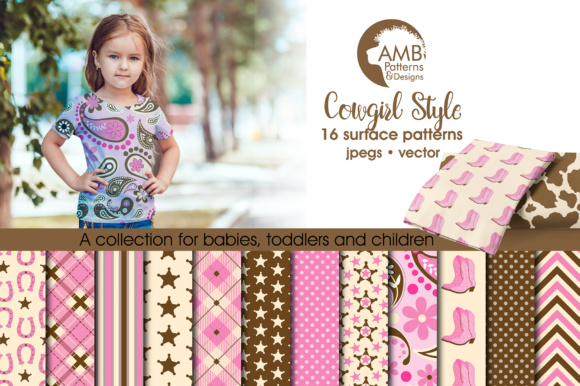
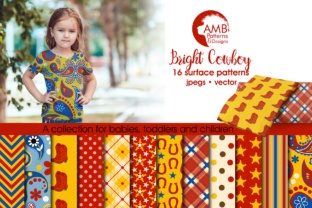
General Cowboy Pattern AMB is a curated set of 16 high-resolution scrapbooking papers designed specifically for crafters who want authentic, cohesive western-themed visuals without compromising print quality or creative flexibility. Unlike generic “cowboy” themed bundles that rely on stock imagery or low-fidelity repeats, this collection uses original, hand-crafted clipart and patterns — including cowboy boots, horseshoes, sheriff badges, stars, plaid, stripes, and subtle western motifs — all rendered with consistent color intensity and stylistic harmony. Each paper measures 12 inches by 12 inches, saved as individual JPEG files at 300 dpi resolution, making them suitable for both digital layout work and professional-grade physical printing.
What Sets General Cowboy Pattern AMB Apart from Other Western-Themed Papers
The distinction lies in execution, not just subject matter. Many western-themed paper packs prioritize quantity over cohesion — mixing inconsistent line weights, mismatched color palettes, or poorly scaled elements that don’t align across sheets. General Cowboy Pattern AMB avoids this by anchoring every design in a unified visual language: warm but saturated base tones (think burnt umber, saddle brown, denim blue, and gold-tinged cream), balanced negative space, and repeat patterns calibrated for seamless alignment when tiled or layered. The use of original clipart — rather than licensed or traced assets — means each motif carries intentional proportion, texture, and stylistic continuity. For example, the sheriff badge pattern doesn’t just sit flat on the background; it integrates with subtle grain overlays and shadowing that echo the depth found in the boot and horseshoe designs.
This level of consistency matters most when building multi-page layouts — like a child’s photo album documenting a first rodeo, a school project on frontier history, or a themed birthday invitation suite. In those cases, visual fatigue from clashing patterns can undermine storytelling, even if individual papers look appealing in isolation.
How It Compares to Broader Categories of Themed Paper Resources
When evaluating General Cowboy Pattern AMB alongside alternatives, it helps to consider three common categories: mass-market themed collections, customizable digital paper generators, and hand-drawn or artisan-printed physical sheets.
- Mass-market themed collections (often sold in craft store bundles or large digital marketplaces) tend to offer broader variety — sometimes 50+ sheets — but frequently sacrifice stylistic unity. Colors may shift noticeably between papers, and motifs often repeat across unrelated themes (e.g., the same star graphic appears in both western and patriotic sets). That can limit versatility in focused projects.
- Customizable digital paper generators let users adjust colors, scale, and layout in real time — useful for matching brand guidelines or specific fabric swatches. However, they rarely deliver the nuanced texture, intentional spacing, or motif integration found in hand-designed sets like General Cowboy Pattern AMB. Output quality also depends heavily on user design skill and software familiarity.
- Hand-drawn or artisan-printed physical papers provide tactile richness and unique imperfections, but lack the scalability and reproducibility of digital files. They’re harder to resize without distortion, can’t be easily recolored or layered digitally, and often come in limited quantities — making reordering or batch printing less reliable.
General Cowboy Pattern AMB sits between these options: it offers the polish and intentionality of a boutique design, the accessibility and consistency of a digital product, and the practicality of standardized dimensions and resolution.
Strengths and Realistic Tradeoffs
Its primary strength is reliability in execution. Because all 16 papers share the same resolution, color profile, and file format (JPEG), users avoid common workflow hiccups — like having to convert PNGs to JPEGs for printer compatibility, adjusting DPI mid-project, or manually resizing mismatched assets. That predictability saves time, especially for educators preparing classroom materials or small-business owners producing custom invitations.
Another practical advantage is thematic specificity without over-narrowing. While “cowboy” might suggest a rigid aesthetic, General Cowboy Pattern AMB includes versatile neutrals (like the subtle plaid and striped papers) that function well as backgrounds or borders — not just focal points. This expands usability beyond overtly western projects into broader rustic, Americana, or even vintage-inspired designs.
Tradeoffs do exist. As a JPEG-only release, it lacks transparency support — so users needing layered elements (e.g., placing photos directly over badge outlines) must work around opaque backgrounds or edit files externally. It also doesn’t include vector versions or SVG cut files, limiting its utility for Cricut or Silhouette users who require scalable outlines for cutting machines. And while the color palette is rich and intentional, it leans warm-toned; designers working with cooler or monochromatic schemes may find limited direct overlap without significant recoloring effort.
Best-Fit Situations — When General Cowboy Pattern AMB Fits Well
This collection shines in scenarios where consistency, ease of use, and thematic authenticity are priorities — and where users have moderate digital literacy but aren’t necessarily professional designers. Examples include:
- A parent creating a personalized “Cowboy Birthday” scrapbook for their son, using printed photos, journaling cards, and die-cut embellishments — all coordinated around the same 12×12 paper base.
- An elementary teacher developing a unit on American westward expansion, needing printable worksheets, bulletin board backdrops, and student handouts that feel visually connected without requiring advanced layout tools.
- A small greeting card maker sourcing background papers for a limited-run “Rodeo Season” collection, where color fidelity and print-ready resolution directly impact perceived quality and customer satisfaction.
In each case, the value isn’t just in the imagery — it’s in the reduced decision fatigue, minimized formatting adjustments, and confidence that all elements will cohere without extra editing.
When You Might Consider Alternatives
General Cowboy Pattern AMB may be less ideal if your work demands transparency, vector scalability, or highly customizable color control. For instance, someone designing web-based interactive storybooks would likely need PNGs with alpha channels. A textile designer adapting motifs for fabric printing might prefer scalable vector files to preserve crispness at large sizes. And if your project calls for precise color matching to Pantone standards or CMYK prepress workflows, JPEGs — while print-ready — won’t offer the same control as layered PSD or professionally separated TIFF files.
Similarly, if you’re assembling a broader western-themed kit — say, combining papers with matching stickers, fonts, and SVG cut files — you’ll need to source those elements separately, since General Cowboy Pattern AMB is strictly a paper collection. That’s not a limitation per se, but it does mean additional evaluation time to ensure stylistic and chromatic alignment across third-party assets.
Making an Informed Choice
Choosing among western-themed paper resources ultimately comes down to matching tool characteristics to project requirements — not just aesthetics. General Cowboy Pattern AMB excels when you need dependable, ready-to-use, high-resolution JPEGs with strong visual continuity and minimal setup overhead. It reflects thoughtful design discipline: restraint in motif count, consistency in tone, and attention to real-world usage constraints like printer compatibility and layout flexibility.
That said, no single resource serves every need. If your workflow relies heavily on layering, transparency, or cross-platform adaptability, supplementing General Cowboy Pattern AMB with compatible PNGs or vectors — or selecting a more modular system — may be worth the added research. The goal isn’t to find the “best” set overall, but the one that reduces friction in your specific context — whether that’s speed, fidelity, scalability, or simplicity.