Panda Girl Digital Paper: A Practical Evaluation for Crafters and Designers
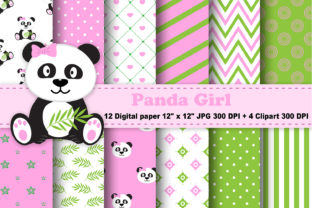
Panda Girl Digital Paper refers to a curated set of high-resolution, printable digital design assets—specifically 12 JPEG papers (12 × 12 inches, 300 DPI) and 4 transparent-background PNG clipart files—delivered in two compressed ZIP files. Unlike generic digital scrapbook papers or mass-produced pattern packs, this collection emphasizes cohesive visual identity, consistent color harmony, and intentional scale relationships between papers and clipart. It’s designed for users who value aesthetic continuity without sacrificing technical flexibility.
What Sets Panda Girl Digital Paper Apart
The most immediately noticeable distinction is its integrated asset structure: the 12 digital papers and 4 clipart elements were created as a unified system—not assembled from disparate sources. Each paper shares a common palette and stylistic sensibility (soft watercolor textures, subtle line work, gentle panda motifs), while the clipart scales meaningfully within that context. For example, the tallest clipart element measures approximately 6 inches at its widest point—intentionally sized to fit comfortably on a 12-inch paper without overwhelming it or requiring excessive resizing.
This cohesion matters when building layered designs—like greeting cards, planner inserts, or digital stickers—where mismatched resolutions, inconsistent lighting, or clashing proportions can undermine professionalism. Panda Girl Digital Paper avoids those pitfalls by maintaining uniform 300 DPI resolution across all files and aligning visual weight across formats. That consistency reduces time spent adjusting brightness, resampling, or manually harmonizing tones—a real workflow benefit for designers working under deadline or with limited editing experience.
How It Compares to Broader Digital Paper Categories
Digital papers fall into several overlapping categories: scrapbook-style patterned sheets, texture overlays, seamless tiles, and thematic collections. Panda Girl Digital Paper sits squarely in the thematic collection category—but with notable emphasis on usability over sheer volume. Many pattern packs offer 30–50 papers per set, but often at the cost of repetition or narrow stylistic range. In contrast, this set delivers 12 thoughtfully varied papers: some feature dense motifs, others lean into negative space; several include subtle gradients, while others rely on hand-drawn linework. The variation supports diverse applications without forcing users to sort through redundant options.
Compared to seamless tile patterns—often used for web backgrounds or large-format prints—Panda Girl Digital Paper prioritizes defined 12 × 12 boundaries. That makes it ideal for physical printing (e.g., cardstock cutting, photo album pages) and structured digital layouts (Canva templates, Procreate canvases). Seamless tiles excel in infinite repetition but may require additional cropping or tiling steps for craft projects where edge alignment matters.
Clipart Integration: Function Over Decoration
The inclusion of four PNG clipart files with transparent backgrounds adds functional dimension—not just visual flair. Because they’re sized to complement the papers (none exceeds ~6 inches in any dimension), they slot naturally into compositions without distortion or pixelation. This contrasts with many clipart bundles that include oversized or undersized elements, requiring disproportionate scaling that degrades clarity—even at 300 DPI.
These aren’t generic “cute panda” icons. They’re designed with compositional intent: one features a seated panda holding a teacup (ideal for invitation accents), another is a minimalist paw print (useful for borders or bullet points), and two include floral-panda hybrids (suited for feminine or botanical-themed projects). Their transparency means they layer cleanly over any paper background—no white boxes, no manual erasing. That’s especially valuable for users unfamiliar with masking or layer blending in design software.
Practical Use Cases and Fit Assessment
Panda Girl Digital Paper works best when your goals align with its design logic: small- to medium-scale printed or digital crafts where thematic unity and print-ready quality matter more than extreme versatility. Examples include:
- Handmade greeting cards (especially birthday, baby shower, or friendship themes)
- Planner stickers and decorative tabs (the 12 × 12 size converts easily to 3 × 4 inch sticker sheets)
- Print-on-demand items like notebook covers or tote bag mockups (thanks to consistent 300 DPI resolution)
- Educational resources for early childhood educators (panda motifs appeal broadly, and soft colors support focus)
- Digital journaling templates where layered transparency enhances depth
It’s less suited for users needing ultra-minimalist monochrome assets, photorealistic textures, or assets optimized for large-format wall art (where seamless scalability or vector formats would be preferable). Similarly, if your workflow relies heavily on animation, interactive PDFs, or SVG-based cutting machines (like Cricut Design Space), the JPEG/PNG format limits direct use without conversion steps.
Tradeoffs to Consider Before Choosing
Like any specialized resource, Panda Girl Digital Paper involves tradeoffs. Its strength—thematic cohesion—also defines its scope. If you regularly switch between stark modern, vintage grunge, and neon cyberpunk aesthetics, this set won’t serve all those needs. It’s not a universal toolkit; it’s a focused solution for specific moods and markets.
File format is another practical consideration. JPEGs are excellent for printing but lack editable layers or transparency. While the included PNG clipart addresses part of that need, you can’t adjust individual pattern elements (e.g., recoloring one motif within a paper) without advanced editing tools and significant effort. Users seeking full customization may prefer vector-based pattern libraries—or be willing to supplement this set with additional assets.
Finally, licensing is worth noting: these are standard commercial-use digital papers, meaning you may incorporate them into physical or digital products you sell (e.g., printable planners, handmade cards), provided you don’t redistribute the original files. That’s typical for the category—but always verify the license terms included with your download, as usage rights can vary subtly between creators.
When to Choose Panda Girl Digital Paper—and When to Look Elsewhere
Choose Panda Girl Digital Paper if you’re designing for an audience that responds well to gentle, approachable visuals—think wellness brands, children’s educators, indie stationery shops, or hobbyists building cohesive personal projects. Its balance of aesthetic warmth and technical readiness (print-safe dimensions, consistent DPI, thoughtful sizing) reduces friction between concept and execution.
Look elsewhere if your work demands maximum format flexibility (e.g., SVG for cutting machines, PSD with layered elements), broad stylistic range within a single purchase, or assets built for motion graphics or responsive web use. Similarly, if you’re sourcing materials for a team with widely varying skill levels—and need plug-and-play compatibility across platforms like Canva, Silhouette Studio, and Affinity Designer—verify how each tool handles JPEG/PNG imports before committing.
Making an Informed Decision
Evaluating Panda Girl Digital Paper isn’t about whether it’s “the best” digital paper—it’s about whether it fits your current project constraints, creative goals, and technical capacity. Compare it not only to alternatives but to your own workflow: How much time do you spend adjusting assets versus designing? Do your end users respond to soft, nature-adjacent themes? Is print fidelity non-negotiable? Does your software handle transparent PNGs reliably?
Real-world testing helps. Try placing one of the included clipart files over two different papers from the set. Notice how easily they integrate—no harsh edges, no tone clashes, no awkward scaling. Then compare that experience to a generic clipart download layered over a stock pattern. That difference in effort and outcome reflects the underlying value proposition: intentionality, not just quantity.
Ultimately, Panda Girl Digital Paper offers what many designers seek but rarely find in bundled assets: a small, reliable set that behaves predictably across uses—without demanding extra labor to make it work.