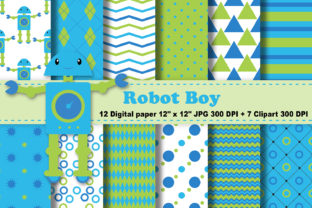
Robot Boy Digital Paper: A Practical Resource for Designers and Educators
Robot Boy Digital Paper is a curated collection of high-resolution, ready-to-use digital design assets aimed at creators who need consistent, thematic visuals without sacrificing flexibility or print fidelity. Unlike generic pattern packs, this set centers on a cohesive robotic aesthetic—clean lines, subtle metallic textures, geometric motifs, and playful tech-inspired elements—while maintaining professional versatility. It’s not novelty wallpaper; it’s functional visual infrastructure built for real projects.
What You Actually Receive—and Why It Matters
The package delivers three distinct but complementary components, each designed with production integrity in mind:
- 12 JPEG digital papers, delivered across three ZIP files—each file containing four coordinated patterns. All are sized to 12 × 12 inches at 300 DPI, ensuring crisp output for both digital display and physical printing (e.g., scrapbooking kits, printable planners, presentation backgrounds, or custom stationery).
- 7 PNG clipart files, bundled separately in one ZIP. Each features a transparent background and scales cleanly up to 8 × 11 inches at 300 DPI—large enough for poster use or layered web graphics, yet precise enough for detail-oriented work like lesson handouts or branded social media templates.
This segmentation isn’t arbitrary. Separating papers from clipart avoids accidental overloading of layers in editing software and supports modular workflow: designers can mix and match base textures with foreground elements without re-rendering or transparency conflicts. It also reflects how professionals actually build assets—layered, intentional, and scalable.
Quality That Holds Up Under Real Use
At 300 DPI and full 12 × 12 sheet size, Robot Boy Digital Paper meets industry standards for commercial print readiness. In practice, that means no pixelation when scaled down for Instagram story templates or enlarged for classroom posters. The JPEGs use sRGB color space—consistent with most desktop monitors and standard printers—so what you see in Photoshop or Canva closely matches final output.
The patterns themselves avoid oversaturation or extreme contrast, which helps maintain readability when overlaid with text or icons. One pattern features a fine grid of circuit-board traces; another uses soft hexagonal tiling with faint gear silhouettes. None dominate—instead, they recede just enough to serve as subtle foundations. This restraint makes them suitable for professional contexts where tone matters: a STEM educator designing a curriculum guide, a small business owner branding a robotics workshop flyer, or a freelance designer building a client’s pitch deck about AI ethics.
The clipart reinforces that same balance. The robot illustrations aren’t cartoonish or overly stylized—they’re simplified but anatomically coherent, with clear joints, expressive eyes, and neutral poses. That makes them adaptable across age groups and applications: a middle-school science teacher can use the same robot icon to label lab stations or animate a slide, while a marketing specialist might integrate it into an infographic comparing automation tools.
Where Robot Boy Digital Paper Fits Best—And Where It Doesn’t
This resource excels in scenarios requiring thematic consistency without creative overhead. Consider these realistic examples:
- A university outreach coordinator preparing printed brochures and digital banners for a “Future Tech Careers” summer camp—using one paper as a background for all materials and rotating clipart to highlight different disciplines (coding, hardware, design).
- A freelance content creator building a Notion template suite for productivity coaches—applying Robot Boy Digital Paper as subtle page dividers or section headers to reinforce a “structured, forward-thinking” brand voice.
- An indie publisher developing a children’s activity book about engineering—embedding clipart into maze pages or using pattern fills for puzzle borders, all while preserving legibility and visual rhythm.
It’s less suited for highly bespoke illustration needs or photorealistic scenes. There’s no animation, no vector scalability (the files are raster), and no alternate colorways included. If your project demands exact Pantone matching, multi-layer PSD files, or SVG versions for web interactivity, Robot Boy Digital Paper won’t fill those gaps. But that’s not its purpose—it’s a time-saving foundation, not a full design system.
Workflow Integration and Practical Flexibility
Because all files are delivered as standard JPEG and PNG formats, compatibility is broad. They open natively in Adobe Photoshop, Affinity Photo, Canva, Figma (via import), and even PowerPoint or Google Slides. No special plugins or license keys are required—just unzip and use.
Designers report particular efficiency when combining papers and clipart in layered compositions. For instance, placing a robot clipart over a subtle circuit-pattern background, then applying a soft drop shadow in Canva, yields polished results in under two minutes. Educators appreciate being able to paste clipart directly into editable PDF worksheets without transparency loss. Small business owners find the uniform sizing eliminates guesswork when prepping assets for print vendors.
That said, users working in strict brand-guideline environments should verify color accuracy before mass production. While sRGB ensures general fidelity, calibrated monitors and printer profiles remain essential for exact reproduction—especially if matching existing corporate colors.
Long-Term Value and Audience Fit
Robot Boy Digital Paper holds value beyond single-use projects. Its cohesion allows reuse across multiple deliverables while maintaining visual continuity—a key asset for educators building year-long curriculum materials or freelancers managing recurring client campaigns. Because the aesthetic leans into timeless tech themes—not fleeting trends like neon cyberpunk or retro-futurism—it remains relevant across product cycles and academic years.
The strongest fit is with professionals who prioritize clarity, consistency, and speed without compromising on polish. That includes:
- Educators integrating visual scaffolding into STEM/STEAM lessons;
- Small business owners launching tech-adjacent services (e.g., coding bootcamps, maker-space memberships);
- Content creators producing themed digital products (printables, Canva templates, LMS modules);
- Marketing specialists supporting internal innovation initiatives or external tech partnerships.
Hobbyists with intermediate design skills will also benefit—but beginners may need basic familiarity with layering and resizing in their chosen tool. There’s no tutorial included, nor instructions for advanced compositing. That’s appropriate: this is a toolkit, not a course.
A Final Observation
In evaluating Robot Boy Digital Paper over several months of actual use—across lesson planning, client presentations, and digital product development—the standout trait isn’t novelty, but reliability. It performs predictably. Colors stay true. Patterns tile cleanly. Clipart integrates without edge artifacts. That kind of quiet consistency is rare in affordable digital asset packs, and it compounds over time: fewer revisions, faster approvals, less backtracking. For anyone regularly translating ideas into visual form—without a dedicated design team—Robot Boy Digital Paper functions as dependable infrastructure, not just decoration.